Digital revolution in cultural institution has the most impact when it is combined with active onsite participation.
MoMA MoMENT reimagines the museum as a vibrant public forum where art is not just observed, but co-created through a participatory installation in the form of collective, shared canvas. By replacing passive viewing with hand-tracking technology that enable drawing, visitors collaborate on digital sketches, transforming strangers into creative partners and capturing their work in a personal digital "MoMA MoMENT Diary" that serves as memorabilia and a visit logbook to the MoMA.
This project is part of a 4-hour sprint at the first ever MoMA hackathon, organized by NYU School of Professional Studies. Out of 65 teams that applied to participate, we were among the 10 teams selected to respond to the challenge:
"How might MoMA reimagine the onsite visitor experience, through design, technology, or communication, to help visitors discover art that resonates with them, and feel more connected before, during, and after their visit?"
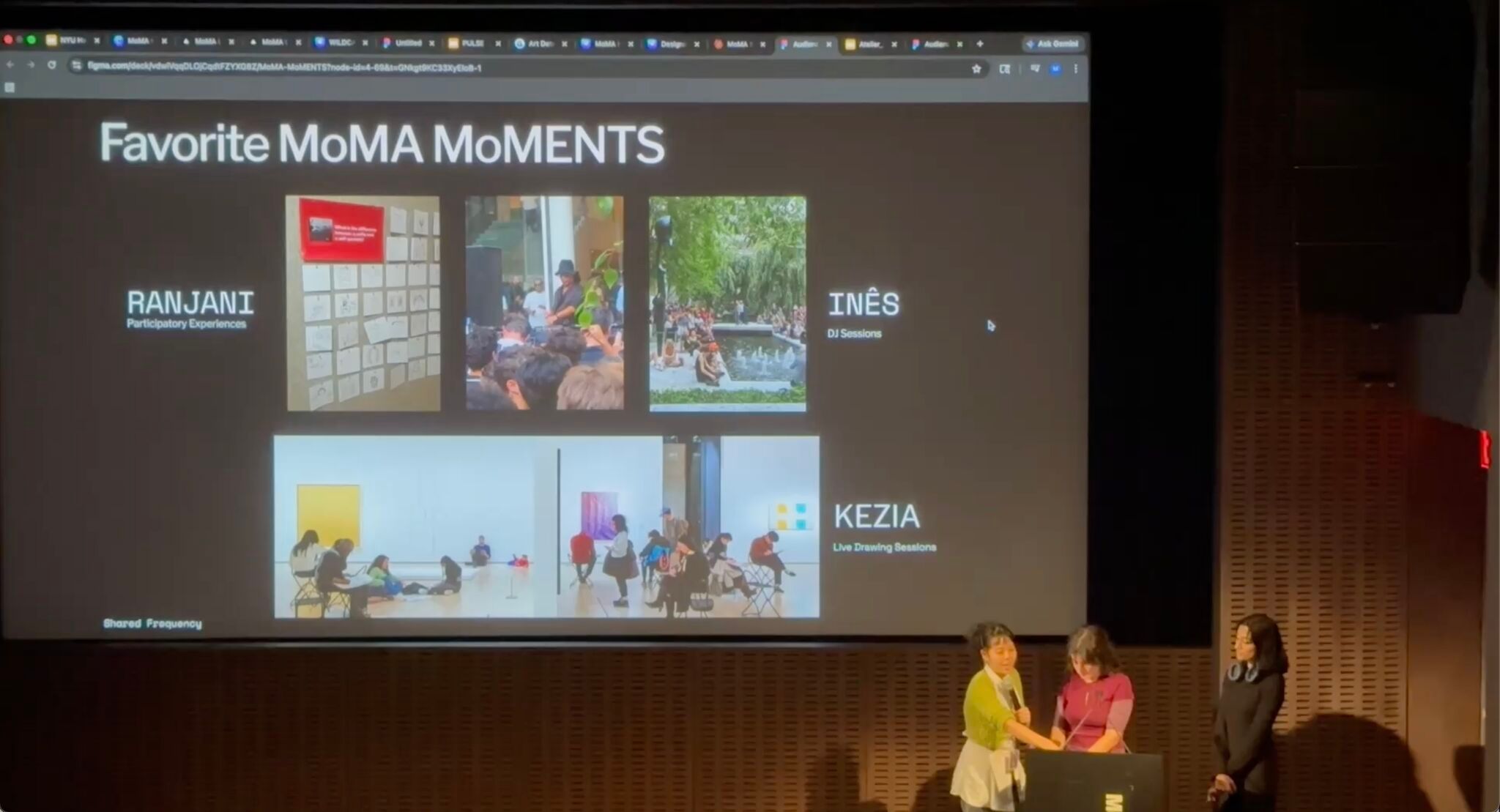
I and my team -- Ranjani Ramakrishnan & Ines Lucas -- took inspiration from our own personal experiences and memories at MoMA and three of us realized that the moments that stayed with us were the ones where we were fully participating with the art and/or present with other people.
Our answer to the challenge is MoMA MoMENT: a collective digital canvas where strangers sit around a circular table and create art together. Using hand tracking, every gesture is rendered into a shared drawing. Each piece can be saved to a personal MoMA MoMENTS Diary, a keepsake of the connections you made and the art you left behind.
By moving away from passive observation toward active creation, the museum can bridge the gap between physical visits and long-term digital engagement.
The museum’s greatest asset isn't just the art. It is a space to gather. And we believe art becomes more meaningful when you make it together with other people as part of the museum community.
A breakdown of MoMA MoMENT proposal:
1. Before the Visit: Understanding the Audience
Current data reveals that MoMA has limited discrete information on its visitors, with 42% of repeat visitors failing to return within a year. To address this, MoMA is shifting its focus toward younger generations (35 and under) who value self-expression and community. The goal is to position the museum not just as a gallery, but as a public forum for gathering.
2. During the Visit: The Collective Canvas
The core of the reimagined experience is an interactive, communal installation in the form of collective, shared canvas space.
- Interactive Technology: Using a circular table equipped with overhead projectors and computer vision (hand-tracking models), visitors use their hands to "paint" on a digital surface without needing their phones.
- The Pilot (Van Gogh’s Starry Night): Since "Where is Starry Night?" is one of the most common questions in the lobby, the pilot experience allows visitors to "Draw like your favorite artist".
- Shared Creativity: Visitors use a specialized palette of colors and brushstrokes derived from the original masterpiece to express their own creativity alongside strangers.
- Human Connection: The circular design encourages "New York Magic"—spontaneous conversation and connection between people who might otherwise remain disconnected.
3. After the Visit: The Digital Museum Diary
Post-Visit: Visitor can access the sketch that they draw collect in the museum.
To ensure the experience doesn't end when the visitor leaves, the "MoMENT" is captured and digitized:
- Shareable Content: Visitors can email their digital creations to themselves, creating a permanent "MoMA MoMENTS Diary".
- Long-term Engagement: This creates a tracker for lifetime visits and preferences, allowing MoMA to "follow them home" through organic social reach and personalized digital interaction.
- Incentive for re-visits: Visitor may discover that on another date of visit, the museum may update the texture and color palette of the installation to match with the ongoing exhibition. This makes the MoMA MoMENT Diary becomes an active, evolving passport.
- Scalability: While it begins with Van Gogh, the "plug-and-play" system is designed to scale to any artist or exhibition in the future.
Visitor may discover that on another date of visit, the museum may update the texture and color palette of the installation to match with the ongoing exhibition. This makes the MoMA MoMENT Diary becomes an active, evolving passport.
Technology
Demonstration of interactive canvas sampled from a painting style
MediaPipe is the backbone of this project as it assists the handtracking to detect where user intends to draw. Drawing is activated by pinching and clicking on an HTML element is activated when user hovers for a few seconds on it.
Camera option and monitor width/height calibration is provided to accommodate different hardware specs to ensure a smooth experience.
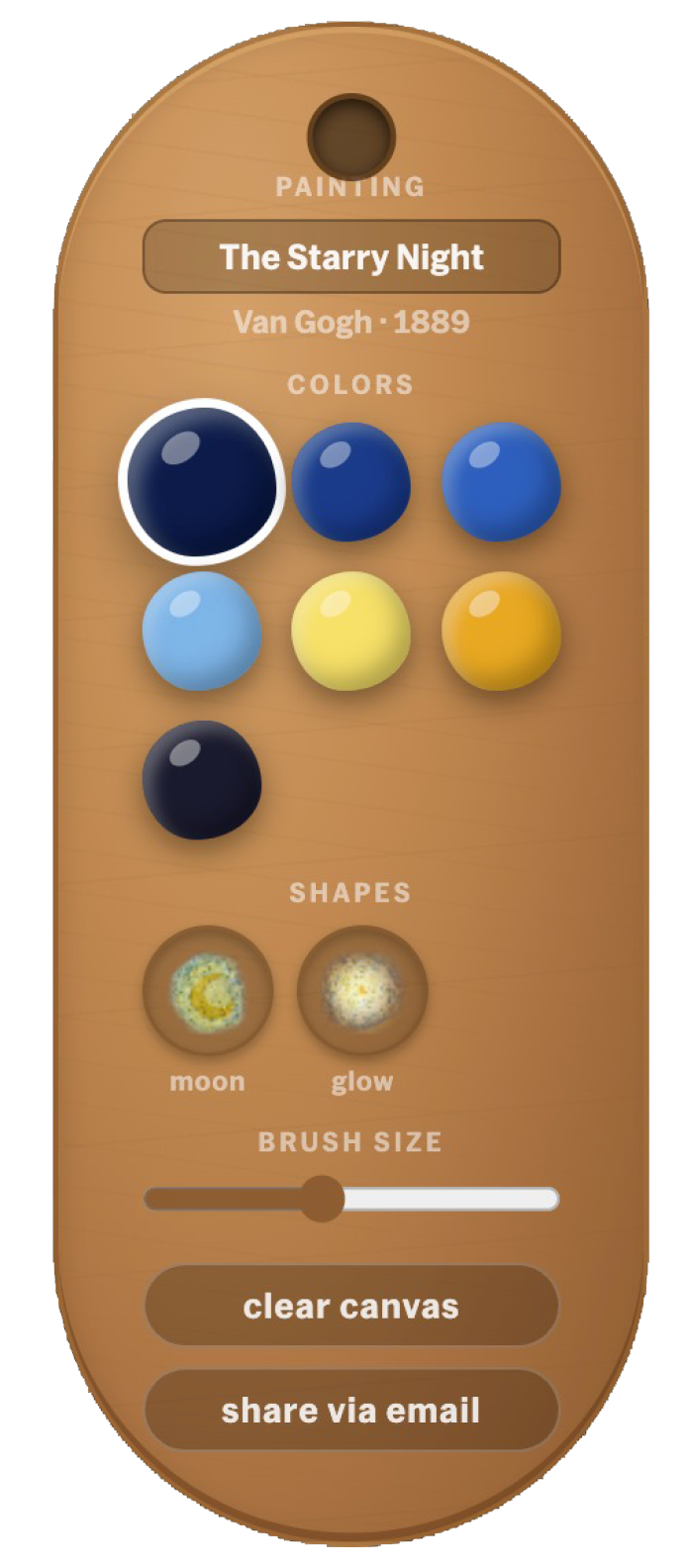
Upon clicking 'Share' button, user will need to define the area of the drawing that they'd like to save. This is unique to this project as user will have to share the canvas with other strangers. That way, user can choose to just 'circle' their drawing, or include other people's drawings.
Afterwards, the drawings will be saved to their MoMA MoMENT Diary, and it includes their date of visit, their MoMA MoMENT diary entry, and the sketch, and a little fun fact about the artist that inspires the texture and color palette assigned to the MoMA MoMENT canvas installation on that particular day.
In an age of AI, creativity and self-expression are MoMA's competitive advantages. By turning a visit into a participatory act, MoMA transforms from a quiet observer of the past into a leader of participatory museum experiences.
Elizabeth Kezia Widjaja © 2026 🙂